BLOG
Contributed Essay to NIRA’s Special Feature on the Future of Society/ Health Promotion Event for the CCD project
Kohei Onozaki contributed an essay titled “Is a Perfect Future Really What We Want?” (Japanese)to a special feature published by the National Institute for Research Advancement (NIRA), one of Japan’s leading policy think tanks, “Dreams of 2050: How Individual Visions Can Open the Door to a New Era.”
The feature brings together 133 essays and opinions from a wide range of contributors, offering diverse perspectives on the future of society. We invite readers to explore the collection.
--
Is a Perfect Future Really What We Want? - Kohei Onozaki
By 2050, our lives may become remarkably comfortable—perhaps too comfortable.
Medical progress will continue to accelerate. Genetic analysis will allow doctors to identify truly effective treatments and preventive measures, extending healthy life expectancy. Just as cancer care has advanced dramatically, dementia prevention and treatment may also make major breakthroughs. Robot-assisted surgery will become more sophisticated, helping to offset shortages of skilled surgeons.
Daily life will grow safer and easier. Autonomous vehicles will be commonplace, reducing traffic accidents and allowing people to travel safely even when tired or distracted.
Mobility innovation may even solve one of Japan’s most pressing local challenges today: emergency medical transport in aging communities.
At the same time, lifestyles will polarize. Some people will choose slower, more deliberate lives. Others will pursue extreme efficiency—maximizing “time performance,” or value per minute. For them, meals may be reduced to three-second “complete nutrition tablets.” Even after losing a stomach to surgery, the body will still receive perfectly calibrated nutrients.
Smartwatches and smart homes will constantly monitor our health, optimizing temperature, water, diet, and exercise. Cities where “simply living there makes you healthier” may become standard. Every social process will be optimized. Disease and stress will decline. A future may arrive in which people can live comfortably without thinking much at all.
And yet, a question lingers.
Is that kind of life truly fulfilling?
I often recall a line from an old television commercial: “Having worries is what makes us human.”
What happens when inconvenience disappears? When frustration is engineered away? When life offers no resistance?
Perhaps it is precisely because life is inefficient, troublesome, and incomplete—because we experience loss as well as gain, discomfort as well as ease—that life feels meaningful. Struggle gives shape to joy. Uncertainty gives weight to choice.
A perfectly optimized future may protect us from pain. But it may also quietly drain life of its texture.
As we race toward a seamless, frictionless society, we should pause to ask not only what technology can do for us, but also what it might take away. Progress should make life healthier and safer—but not empty of challenge, reflection, or human depth.
Comfort alone is not the goal. A life worth living is more complicated than that.
--
-
Speaker at a Public Health Awareness Event in Asahi City, Chiba
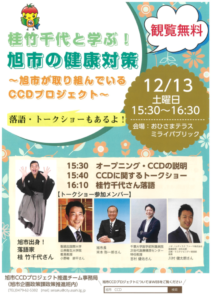
Onozaki also spoke at a public awareness event focused on the CCD Project, a public–private–academic partnership led by Asahi City, Chiba Prefecture, aimed at advancing health promotion and disease prevention. The event, titled “Learning About Asahi City’s Health Initiatives with Katsura Chikiyo: The CCD Project in Action” (Japanese) highlighted the city’s collaborative approach to community health.
A recording of the event is available on YouTube.